
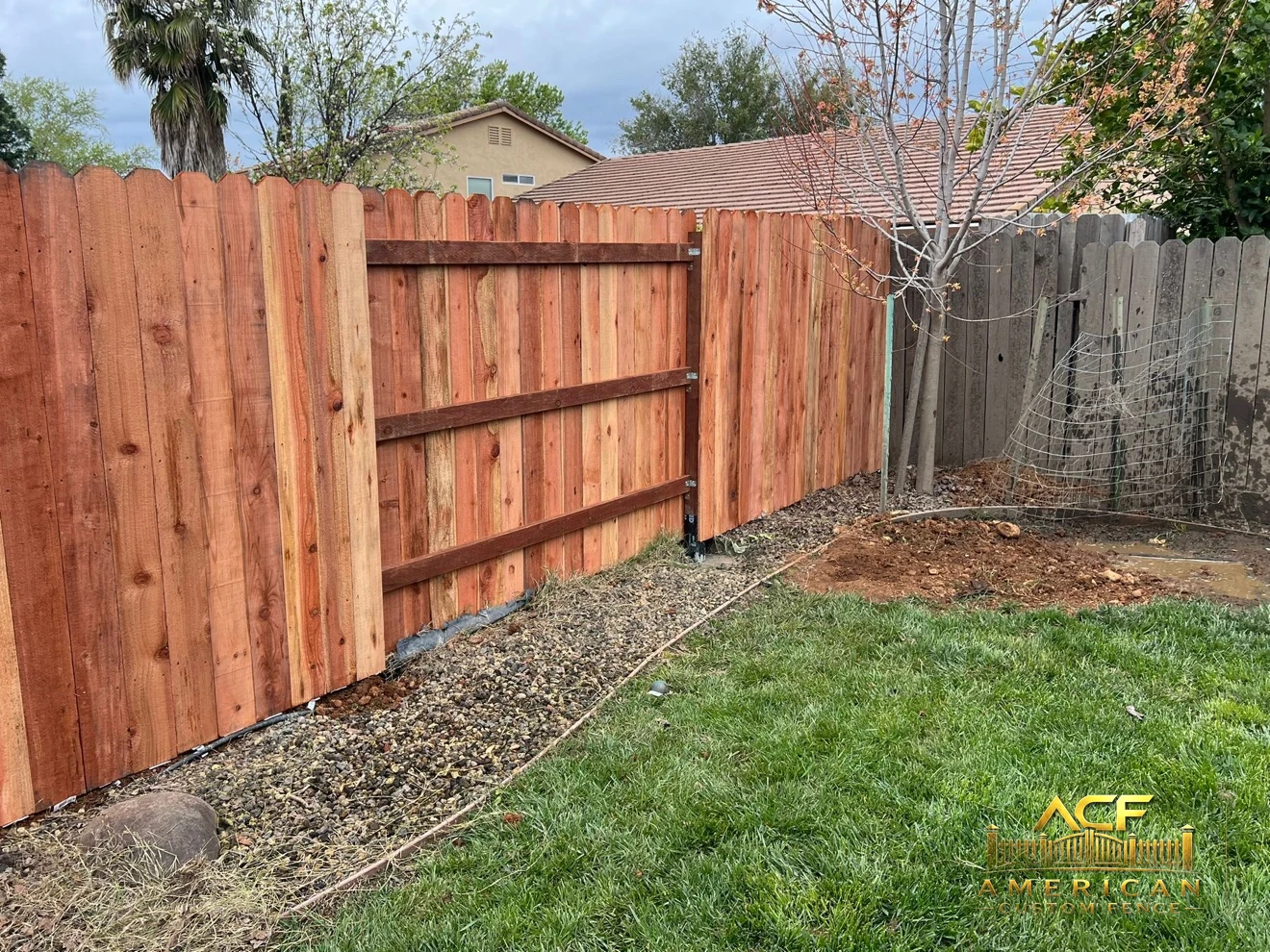
On the day it is built, a standard privacy fence and a board-on-board fence can look almost identical: a clean, solid wall of redwood. The difference shows up about one Sacramento summer later. The standard fence has opened thin vertical gaps between its boards — enough to see a neighbor’s patio light through at night. The board-on-board fence still looks exactly the way it did on day one.
Neither fence is “better” in the abstract. They are two different answers to one physical fact — wood shrinks across its width — and the right choice depends on how much privacy you actually need, what your site does with wind, and which side of the fence you will be looking at. This article compares them on those three things, plus the honest cost drivers (no prices — every yard is different, and a number here would mean nothing for yours).
One definition first, because the industry uses the name loosely. In this article, board-on-board means two layers of pickets on the same face of the rails: a first layer hung with gaps between the boards, and a second layer centered over those gaps so each board overlaps its neighbors on both edges. (A fence with boards alternating on opposite faces of the rails is a shadowbox fence — a different style, mentioned briefly below.)
The Privacy Difference: Designed-In Shrinkage vs. Day-One Tightness
A standard privacy fence is one layer of pickets butted edge to edge. It is fully private the week it is built. Its privacy problem is arithmetic:
- Wood shrinks and swells only as its moisture content changes below the fiber saturation point, about 30% — and it shrinks most across the board’s width (tangentially), roughly twice as much as it does radially, per the USDA Forest Products Laboratory’s Wood Handbook (Chapter 4).
- For redwood, the Wood Handbook lists total shrinkage from green to oven-dry at 4.4% tangential for old growth and 4.9% for young growth. A fence picket in service never goes green-to-oven-dry, so real seasonal movement is smaller — but even 2% across a 5.5-inch picket is about 1/8 inch, and that movement happens at every joint, in the same direction, all summer long.
- Sacramento’s climate drives the cycle hard: wet winters push moisture in, long hot dry summers pull it back out. Boards installed tight in spring open their gaps by August.
None of that makes a standard fence a bad fence — the gaps are thin, they close back up in the wet season, and from most angles at most distances you still cannot see detail through them. What you lose is the guarantee: straight-on, close-up, at the wrong sun angle, a shrunken standard fence leaks sight lines.
Board-on-board removes the arithmetic from the question. The second layer is centered over the first layer’s gaps with a real overlap on each edge — Simpson Strong-Tie’s own published board-on-board fence design (DIY-CSWDFNC15) is drawn with a 1-inch overlap. When both layers shrink, the overlap narrows, but there is never a straight path through the fence: a shrinking board uncovers more of the board behind it, not your neighbor’s yard. Privacy stops depending on the season.
Choose on this factor if: the fence faces a close neighbor, a pool, a patio you use at night, or a second-story window looking down at an angle. Angled views are where the difference is largest — a standard fence’s thin gaps line up into a see-through slot from the side, while an overlap has no slot at any angle.
Wind: Both Fences Are Sails — the Posts Decide
A common hope is that board-on-board “lets some wind through.” It does not. Under the wind-load framework of ASCE 7, the force on a fence rises with its solidity — how much of its face is solid — and both of these fences are essentially solid walls. Board-on-board adds a second layer of wood weight, not a pressure release. If wind relief is the goal, the style that actually passes some air is shadowbox, whose alternating boards leave angled passages — at the cost of angled see-through views.
So for either fence in this comparison, wind resistance is decided below the pickets:
- Post depth and concrete. Wind load on a solid 6-foot fence concentrates at the posts. Our standard build sets posts 2 to 3 feet deep in concrete — Simpson Strong-Tie’s fence guides give the same rule of thumb (about 2 feet in the ground for a 6-foot fence, concrete for strength and durability) — with a waterproof wrap below ground against the rot that weakens posts at the ground line.
- Rails and connections sized for the weight. Board-on-board hangs roughly a fifth more picket weight on the same rails and posts (see the board counts below). That is a reason the frame matters more, not less: pressure-treated rails, and Simpson connectors and screws instead of nails, so the heavier skin stays tight to the frame as the wood moves.
- Exposure honesty. A solid fence on an open, windy lot — a corner lot, a hilltop, a long unbroken run with nothing breaking the wind — works harder than the same fence in a sheltered backyard, in either style. Tell your builder about the exposure; it can change post spacing and depth, and it should.
What Each Fence Looks Like — From Both Sides
From the finished face:
- Standard: one flat plane of pickets. Clean, simple, and the look most Sacramento yards already have.
- Board-on-board: the same pickets, but the overlapping layer gives the face depth — a stepped profile with shadow lines that read as a more built, more finished wall, especially in low sun.
From the back:
- Both fences, built the usual way, show the same thing on the back side: the rails and posts, with the picket layer on the far face. Board-on-board does not automatically finish both sides — its second layer sits on the same face as the first.
- If both sides need to look finished — a shared fence both neighbors see from their patios — that is a separate build decision: boards on both faces (the shadowbox family), or a standard fence with the finished face agreed in advance. California’s Good Neighbor Fence Act framework makes that a conversation worth having with the neighbor before the fence goes up, not after; our article on that Act explains the notice and shared-cost basics.
The Cost Drivers (No Prices — What Actually Moves the Number)
We publish no prices in these articles, because a fence quote is built from your footage, ground and gates. But the drivers that separate these two styles are fixed, and you can hold any quote up against them:
- Board count. This is the big one. Simpson Strong-Tie’s published plans make it concrete: their board-on-board design uses 20 pickets per 8-foot section, where their comparable single-layer fence plan uses 17 — roughly 18% more boards for the same fence, before cuts and waste. More boards is more material, full stop.
- Fasteners and labor time. Every extra board is extra screws and extra alignment work — an overlap has to be kept consistent board after board, or the shadow lines wander. Board-on-board simply takes longer to hang straight.
- Frame load. The heavier skin argues for the full-strength frame — posts at full depth in concrete, sound rails, connectors — rather than savings taken out of the structure. On a board-on-board quote, structure is the wrong place to economize.
- Repairs later. A single damaged picket on a standard fence is a five-minute swap. On board-on-board, a damaged back-layer board means removing the overlapping board in front of it first — a slightly bigger job for the same broken board.
- What does NOT change: footage, post count on a typical layout, concrete, gates and hardware are the same either way. If two quotes for the two styles differ by far more than boards, fasteners and hanging time explain, ask where the rest went.
So Which One Is Right for You?
Board-on-board fits when:
- Privacy is the point of the fence — close neighbors, a pool or spa, a patio used after dark, or upper windows looking in at an angle.
- You want the fence to look the same in August as it did in April, with no seasonal gaps.
- The finished face is the side you see, and you like the deeper, shadow-lined profile.
A standard privacy fence fits when:
- The fence is a boundary first and a screen second — side yards, long runs, places nobody looks through at close range.
- You would rather put the budget difference into footage, a gate, or the structure underneath.
- Thin seasonal gaps simply do not bother you — for many yards, they genuinely do not matter.
Either way, the pickets are the part you see, but the posts are the part that decides how long either fence stands straight. Our build standard does not change with the style: posts set 2 to 3 feet deep in concrete with a waterproof wrap below ground, pressure-treated posts and rails, redwood pickets, and Simpson connectors and screws throughout — never nails. Every fence we build in full carries our 24-month workmanship warranty on work performed completely by us, for projects contracted from November 4, 2026. When the work is finished, the walkthrough is an invitation to walk the line with us — never a sign-off or a payment condition.
Frequently Asked Questions
Does board-on-board really stay private forever?
It stays private as the boards shrink, which is the failure mode of a standard fence — the overlap is sized (about an inch per edge in Simpson Strong-Tie’s published design) so seasonal shrinkage narrows the overlap instead of opening a gap. Wood still ages, checks and can warp over the years, which is a maintenance and materials question, not a sight-line one.
Is board-on-board the same as shadowbox?
No, though the names get mixed up in quotes. Board-on-board puts both layers on the same face of the rails, overlapped — no see-through angle. Shadowbox alternates boards on opposite faces: it looks finished from both sides and passes some air, but at an angle you can see through it. If a quote says “board-on-board,” ask which face the second layer goes on.
Does board-on-board handle wind better?
No — both styles are solid, and solid fences catch the full wind load for their size and exposure (the solidity principle in ASCE 7’s fence framework). Board-on-board is also heavier. Wind performance comes from post depth, concrete, spacing and connections in both styles.
Can I convert my existing standard fence to board-on-board by adding a second layer?
Sometimes — if the posts and rails are sound and sized to carry the extra weight, a second overlapped layer can be hung on the existing frame. If the posts are near the end of their life, the added boards buy privacy on a fence whose structure is still aging out; our replacement-signs article walks through how to tell which case yours is.
Why does board-on-board cost more if the posts and rails are the same?
Boards, fasteners and time: roughly a fifth more pickets (20 vs. 17 per 8-foot section in Simpson Strong-Tie’s published plans), each one screwed and aligned to hold a consistent overlap. The structure underneath is unchanged — the difference is in the skin.
Ready to Decide With the Fence Line in Front of You?
Walk your fence line, note which stretches face a neighbor’s windows or patio and which are just boundary, and then call us. We will measure, talk through both styles against your actual sight lines and exposure, and quote the one that fits — or a mix, standard on the boundary runs and board-on-board where privacy actually matters.
Call American Custom Fence at (916) 579-3063 for a free estimate. Licensed, Bonded & Insured — CSLB License #1105341. Serving Sacramento and surrounding areas.
Sources: USDA Forest Products Laboratory, Wood Handbook Chapter 4 “Moisture Relations and Physical Properties of Wood,” General Technical Report FPL–GTR–190 (shrinkage and swelling only below the fiber saturation point, ~30% moisture content; tangential shrinkage roughly twice radial; redwood green-to-oven-dry shrinkage 4.4% tangential / 2.6% radial old growth, 4.9% / 2.2% young growth), with the same shrinkage table as summarized in Oklahoma State University Extension, “Dimensional Changes in Wood”; Simpson Strong-Tie DIY project guides DIY-CSWDFNC15 “Sturdy Fences That Stand Up to the Elements” (board-on-board design drawn with a 1-inch overlap; 20 pieces of 1×6 per 8-foot section; 6-ft fence post rule of thumb ~2 ft in ground, concrete for strength and durability) and DIY-CSPGT15 (comparable single-layer fence plan, 17 pieces of 1×6 per 8-foot section); ASCE 7, Minimum Design Loads and Associated Criteria for Buildings and Other Structures, Chapter 29 framework (wind force on fences rises with the solidity of the fence face). All sources read and verified November 23, 2026.