
Ask any experienced fence builder what kills fences, and you’ll hear the same answer: it’s rarely the boards. It’s the posts — and more specifically, how deep they were set. A fence is a long, flat sail standing in the wind, and everything that sail catches is transferred straight down to a handful of posts in the ground. If those posts are shallow, the fence leans. If they’re set right, the fence can stand straight for decades.
Here’s the standard we build to, and why Sacramento’s soil makes it matter more here than in most places.
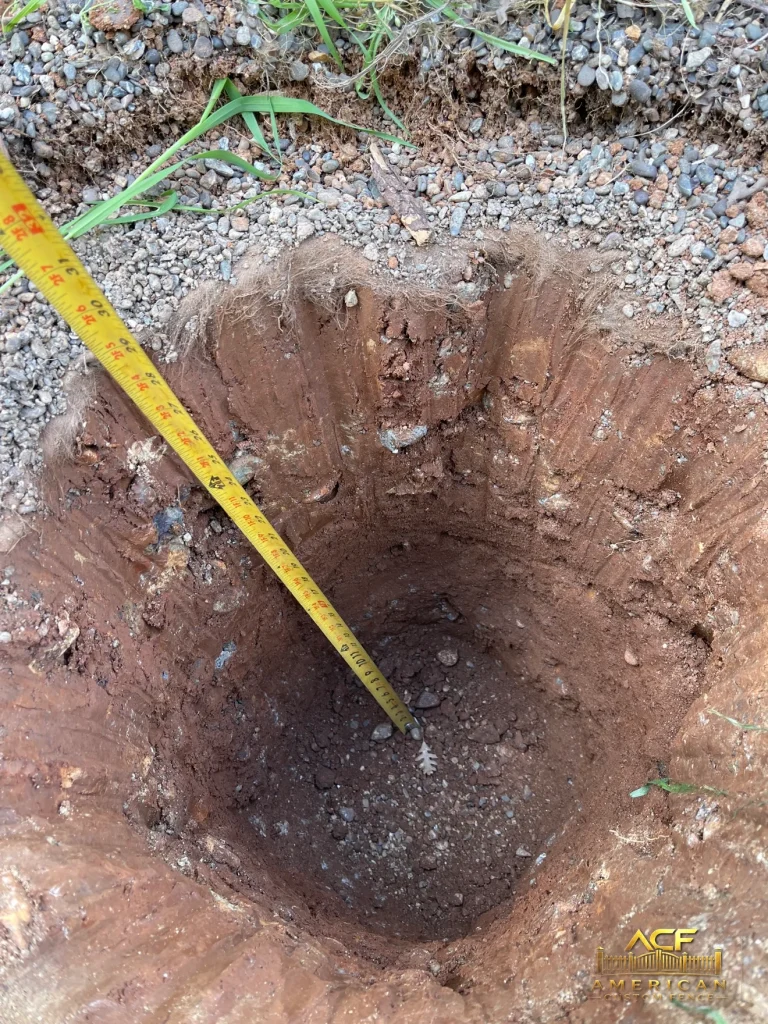
How Deep Should Fence Posts Be? The Short Answer: 2 to 3 Feet, in Concrete
For a standard 6-foot residential fence, how deep should fence posts be? 2 to 3 feet deep in concrete — that’s the standard we use on every fence we build in Sacramento, Fair Oaks, Roseville, Folsom, and the surrounding area. A good rule of thumb in the trade is that about a third of the post should be below ground for a typical fence, and taller fences, gate posts, and corner posts deserve the deeper end of the range because they carry more load.
Depth alone isn’t the whole story, though. A deep post in loose, backfilled dirt can still work loose. Depth plus a real concrete footing is what locks a post in place.
Why depth matters more in Sacramento clay
Sacramento-area soil is famously clay-heavy, and clay behaves very differently from sandy or loamy soil:
Clay shrinks and swells. In summer, Sacramento clay dries out and contracts, pulling away from whatever is buried in it. In winter, it absorbs water, swells, and turns heavy and slick. A post set shallow in clay gets worked back and forth by this cycle, season after season, until its hole is effectively bigger than the post — and the fence starts to move.
Wind load is the real enemy. Unlike colder parts of the country, Sacramento has a shallow frost line, so frost heave is a minor concern here. What we design for instead is wind. Winter storms push hard against a solid privacy fence, and that force concentrates at the base of each post. A deep concrete footing gives the post a heavy, wide anchor that resists that leverage. A shallow one acts like a hinge.
Water collects in clay. Clay drains slowly, so moisture sits around the buried part of a post longer than it would in freer-draining soil. That’s the second reason depth has to come with protection — more on that below.
How we set a post so it stays set
Depth is step one. Here’s the full method we use on every build:
- Dig to depth. Holes are dug 2 to 3 feet deep, sized to give the concrete real mass around the post — we typically use 3 to 4 bags of concrete per post on the main line.
- Wrap the post below grade. The buried section of each post gets a waterproof post wrap. Ground moisture is what rots posts out from the inside, and the most vulnerable point is right at the ground line, where water and air meet. The wrap seals that section off.
- Use pressure–treated lumber. Our posts and rails are pressure-treated and rated for ground contact, so the wood itself is built to survive Sacramento weather.
- Set in concrete, plumb and braced. The post is set in concrete, checked for plumb, and braced while the concrete cures, so the line starts straight and stays straight.
- Fasten with connectors and screws. Above ground, we build with Simpson connectors and screws — never nails that back out and loosen over time.
The result is a fence whose strength doesn’t depend on how tightly someone packed dirt around a post.
Signs your posts were set too shallow
If your current fence has any of these problems, shallow footings are a likely cause:
- The whole line leans in one direction, especially after winter storms
- Posts feel loose when you push on them, or move in their holes
- Gates sag or drag because the gate post has shifted out of plumb
- Gaps open at the ground line where soil has pulled away from the post
- Rot right at ground level, where a post stayed wet in a loose, shallow hole
A single loose post can sometimes be reset. But when a whole line was set shallow, the honest fix is usually to rebuild it on proper footings — otherwise you’re paying to straighten the same fence again and again.
What about gate posts and taller fences?
Gate posts carry the weight of a swinging gate plus the force of it latching, slamming, and being leaned on, so they get the deepest, heaviest footings on the fence. Corner and end posts that terminate a run deserve the same treatment. And if you’re building a 7- or 8-foot fence for privacy, every post should be at the deep end of the range — a taller fence catches more wind, and the extra height multiplies the leverage at the base.
Frequently asked questions
How deep should fence posts be for a 6-foot fence?
Two to three feet deep in concrete is the standard we build to in the Sacramento area. In our clay soil, going shallower than 2 feet invites leaning within a few seasons.
Is concrete really necessary, or is packed gravel/dirt enough?
In clay, concrete matters. Packed dirt shrinks away from the post as it dries, and gravel alone doesn’t give a tall privacy fence enough resistance to wind leverage. A concrete footing is a single solid anchor that moves as one piece with the post.
Does Sacramento’s frost line affect post depth?
Very little. Our winters are mild and the frost line is shallow, so unlike in colder states, depth here is about wind load and clay movement — not frost heave. That’s good news: we can put the depth where it actually does the work.
Can a leaning post be fixed without replacing the fence?
Sometimes one post can be dug out and reset. But if the fence leans because every post was set shallow, resetting one post just moves the weak point. At a free estimate visit, we’ll tell you honestly which situation you’re in.
Get a fence that’s set right the first time
If your fence is leaning — or you’re planning a new one and want it built on footings that match Sacramento soil — we can help. American Custom Fence is the fencing division of American Gardens Landscaping, based in Fair Oaks and serving Sacramento, Roseville, Folsom, El Dorado Hills, Carmichael, Citrus Heights, and Rancho Cordova. Every fence we build is set 2 to 3 feet deep in concrete with waterproof post wrap, and every fence comes with our 24-month workmanship warranty, for projects contracted from November 4, 2026.
Call (916) 579-3063 for a free on-site estimate.
Licensed, Insured & Bonded — CSLB License #1105341