
Pool fence rules in California: A backyard fence and a pool fence are not the same thing in California law — and the difference is not a technicality. A yard fence keeps people out of your property. A pool enclosure, as the state defines it, isolates the pool from your own house, so that a child who slips out a back door still cannot reach the water. If you are building a pool, remodeling one, or replacing the fence around one, the rules below are the ones your inspector will work from.
This is general information from the statute itself — California’s Swimming Pool Safety Act, Health and Safety Code sections 115920 through 115929 — not legal advice for a specific property. The exact text lives at California Legislative Information (leginfo.legislature.ca.gov), and your city’s building department has the final word on your permit.
When the State Rules Are Triggered
The Act’s main requirement switches on at a specific moment: when a building permit is issued for the construction of a new swimming pool or spa, or the remodeling of an existing swimming pool or spa, at a private single-family home (Health & Safety Code §115922(a)).
A few definitions decide what counts:
- A “swimming pool” is any structure intended for swimming or recreational bathing that contains water over 18 inches deep — in-ground and aboveground, and expressly including hot tubs, spas, portable spas, and nonportable wading pools (§115921(a)).
- An “enclosure” is a fence, wall, or other barrier that isolates the swimming pool from access to the home (§115921(c)). That word “isolates” is the heart of the law: a fence that only rings the backyard, with the house opening straight onto the pool deck, is not the barrier the statute describes.
- The Act does not apply to public swimming pools, to hot tubs or spas with locking safety covers that comply with the ASTM International F1346 standard, or to apartment complexes and other residential settings that are not single-family homes (§115925).
Before final approval of the permitted work, the local building code official inspects the drowning prevention safety features and gives final approval only if no violations are found (§115922(c)). In other words, these are not guidelines — they are checked, in person, before your project is signed off.
The Two-of-Seven Rule
When the Act is triggered, the pool or spa must be equipped with at least two of the following seven drowning prevention safety features (§115922(a)):
- An enclosure that meets the requirements of section 115923 (detailed below) and isolates the pool or spa from the home.
- Removable mesh fencing that meets the ASTM International F2286 standard, together with a gate that is self-closing and self-latching and can accommodate a key lockable device.
- A safety pool cover — manually operated or power-operated — accompanied by a label verifying it meets ASTM International F1346-23.
- Exit alarms on the home’s doors and windows that provide direct access to the pool or spa without an intervening enclosure. When a door or window is opened or left ajar, the alarm must sound a continuous audible alarm or a repeating verbal warning (such as “the door to the pool is open”); it may be battery operated or wired into the building.
- A self-closing, self-latching device on the home’s doors providing direct access to the pool or spa, with its release mechanism placed no lower than 54 inches above the floor.
- A pool alarm in good repair that sounds on detection of accidental or unauthorized entry into the water, independently certified to ASTM International F2208. (An alarm worn by an individual child does not qualify.)
- Other means of protection that afford equal or greater protection and have been independently verified by an approved testing laboratory as meeting ASTM International, ASME, or other nationally recognized standards, with a label verifying it.
Watch the combinations that do not count. Section 115922(b) says the two-feature requirement is not satisfied by an exit alarm and a self-closing device on the same door, by an exit alarm and a door latch on separate doors, or by a safety pool cover paired with a pool alarm. Two features only count when they are genuinely two layers of protection.
For most Sacramento-area homes, the enclosure is one of the two features — which is where the fence itself has to meet an exact specification.
Pool Fence Rules California – The Enclosure Specification: Section 115923
An enclosure must have all of the following characteristics (§115923). Miss one, and it does not qualify:
- Height: at least 60 inches (five feet) (§115923(b)).
- Ground clearance: no more than 2 inches from the ground to the bottom of the enclosure (§115923(c)). A fence that follows sloping ground carelessly can pass at one post and fail at the next low spot — the gap is measured where the gap actually is.
- Openings: no gap or void may allow passage of a sphere 4 inches or greater in diameter (§115923(d)). This is the rule that decides picket and bar spacing on a metal pool fence: the spacing that looks fine to an adult eye is tested with a 4-inch sphere.
- Gates: any access gate must open away from the pool, be self-closing, and have a self-latching device placed no lower than 60 inches above the ground (§115923(a)). Note that this 60-inch latch height for enclosure gates is a different, higher figure than the 54-inch release height for house doors in feature 5 above — the two numbers are easy to confuse and they are not interchangeable.
- No climbable outside face: the outside surface must be free of protrusions, cavities, or other features that would serve as handholds or footholds enabling a child under five to climb over (§115923(e)). Horizontal rails on the outside face, decorative cut-outs, and nearby climbable objects all work against this rule — which is why pool enclosures are usually smooth-faced metal or solid fencing with the structure on the pool side.
One practical consequence deserves emphasis: because the enclosure must isolate the pool from the home, the gate hardware does the daily work. A self-closing hinge that has gone weak, or a latch set too low or propped open, turns a compliant fence into a non-compliant one without a single board moving. Gate hardware is not a finishing touch on a pool fence; it is half the law.
Pool Fence Rules California: What This Means When You Choose a Pool Fence
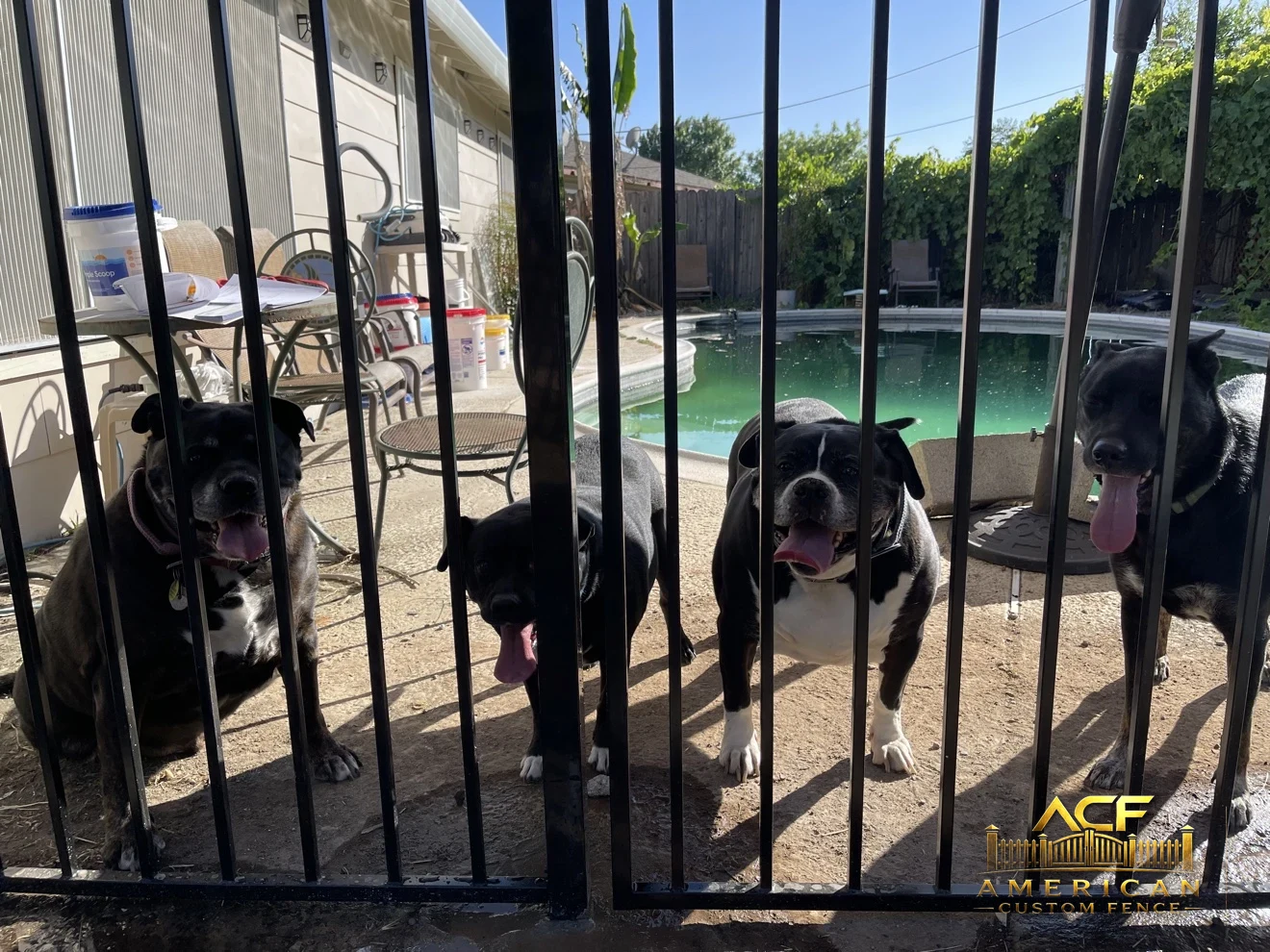
Metal is the common Sacramento choice for a reason. A black metal fence with vertical bars spaced to the 4-inch sphere rule, a smooth non-climbable outside face, and a self-closing, self-latching gate hung to swing away from the water fits the section 115923 specification naturally — the Carmichael pool fence in this article’s photo is exactly that style. Wood and other materials can be built to the same numbers, but the climbability and gap rules are harder to keep honest as wood moves with the seasons.
Build to the numbers, then keep them. Our pool-area fences are built like all our fences: posts set deep in concrete so the line — and the gate’s alignment with its latch — stays where it was set. A gate that sags even slightly stops self-latching, and a self-latching gate that no longer latches is the single most common way an older pool enclosure quietly falls out of specification. (Our article “Choosing a Gate That Won’t Sag” is coming to this blog; the same frame-and-post principles are in our Gates page.)
Check the layers around the fence, too. If your second feature is an exit alarm or a self-closing house door, that device is part of your compliance — test it when you test the gate. And anyone who builds your pool or does permitted work on it is required to give you notice of the Act’s requirements (§115924(a)), so a pool project that never mentions these rules is a project to question.
HOA and city rules sit on top of the state floor. A planned community can impose its own height, style, and color approvals for a pool fence (see our HOA fence rules article), and the Act reserves interpretive authority to local jurisdictions (§115927) — your city building department confirms what applies at your address before you build.
Frequently Asked Questions
My backyard is already fenced. Does that count as my pool enclosure?
Only if that fence actually isolates the pool from the home and meets every characteristic in section 115923 — 60-inch minimum height, 2-inch maximum ground clearance, the 4-inch sphere rule, a non-climbable outside face, and a self-closing, self-latching gate opening away from the pool with the latch no lower than 60 inches. A typical yard fence fails at least the isolation test, because the house usually opens directly into the yard — and often the gate test as well.
Do I need two safety features, or is a good fence enough on its own?
At least two, whenever a permit is issued for a new pool or spa or a remodel at a single-family home (§115922(a)). A compliant enclosure is feature one; pick the second from the remaining six — and check section 115922(b) so you do not pair two features the law says cannot be combined.
How tall does a California pool fence have to be?
At least 60 inches — five feet — measured as the enclosure’s minimum height under section 115923(b). Separately, the gate’s self-latching device must sit no lower than 60 inches above the ground (§115923(a)). Do not confuse that gate figure with the 54-inch minimum release height, which applies to self-closing devices on the house’s own doors (§115922(a)(5)).
Does the Act cover my spa or hot tub?
The definition of “swimming pool” includes hot tubs and spas with water over 18 inches deep (§115921(a)). But hot tubs and spas with locking safety covers that comply with ASTM International F1346 are exempt from the article (§115925(b)).
Who checks that my pool fence complies?
The local building code official, who must inspect the drowning prevention safety features before final approval of the permitted construction or remodeling (§115922(c)).
My pool was built years ago and I am only replacing the fence. Do these rules apply to me?
The Act’s two-feature requirement is written around building permits for new construction and remodeling, and fence work itself may need a permit and inspection under your city’s rules. Because the trigger depends on the permit, the reliable move is to ask your city building department about your specific project before work starts — and to build any replacement enclosure to the section 115923 numbers regardless, since those are the figures an inspector will measure against.
Planning a Pool Fence in the Sacramento Area?
Tell us where the pool sits, where the house doors open, and which second safety feature you are planning, and we will lay out an enclosure that is built to the section 115923 numbers from the first post — and still looks like it belongs in your yard.
Call American Custom Fence at (916) 579-3063 for a free estimate. Licensed, Bonded & Insured — CSLB License #1105341. Serving Sacramento and surrounding areas.
Sources: California Health & Safety Code §§115920–115929 (Swimming Pool Safety Act), including §115921 (definitions), §115922 (two-of-seven drowning prevention safety features; combinations that do not satisfy; local inspection before final approval), §115923 (enclosure characteristics), §115924 (consumer notice) and §115925 (exemptions), official text at California Legislative Information, leginfo.legislature.ca.gov (text verified Nov 9, 2026, including the 2024 SB 552 amendments effective Jan 1, 2025); ASTM International standards F2286, F1346-23 and F2208 as named in §115922.
Regulations change. For the latest updates, please contact your city to confirm before building.