
If you live in a planned community in the Sacramento area — and in newer parts of Roseville, Folsom, Rancho Cordova, and El Dorado Hills, that describes a lot of neighborhoods — HOA fence rules mean your fence answers to two sets of rules, not one.
The first is public law: your city’s height limits, setbacks, and building codes. The second is private: your homeowners association’s governing documents — the CC&Rs (the recorded declaration), the architectural guidelines, and the operating rules you agreed to when you bought the home.
Here is the part that trips people up: the two approvals do not substitute for each other. A fence can be perfectly legal under city code and still violate your HOA’s rules. And an HOA approval does not excuse a fence that breaks city code — California law says so expressly, as you’ll see below. This guide walks through what HOAs typically control, what California’s Davis-Stirling Act requires of the approval process itself, and the checklist to run through before anyone digs a post hole. It is general information, not legal advice.
What HOAs Typically Control About a Fence
There is no single statewide list — every association’s documents are its own. But across Sacramento-area communities, architectural guidelines most often speak to:
- Height — often a specific maximum, and sometimes a required exact height so a street of fences reads as one line
- Material and style — for example, wood only, a named picket style, masonry perimeter walls, or no chain-link visible from the street
- Color and finish — an approved stain or paint palette, sometimes a single community color
- Placement — setbacks from sidewalks and streets, and rules for corner lots and fences visible from common areas
- Which side faces out — many communities require the finished face toward the street or the neighbor
- Gates — style, hardware, and whether gates must match the fence
- Community and perimeter walls — the masonry or stucco walls that ring many newer subdivisions, which are usually the association’s, not yours (more on that below)
The only way to know your community’s actual list is to read your own documents. Start with the declaration (CC&Rs) and the architectural guidelines. If what you’re planning isn’t addressed there, ask the association or its management company — in writing — before you assume it’s unregulated.
One legal frame worth knowing: under California Civil Code §4350, an association operating rule is valid and enforceable only if it is in writing, within the board’s authority, not in conflict with governing law or the declaration, adopted in good faith, and reasonable. And under §4205, if documents conflict, the law prevails over the governing documents, and the recorded declaration prevails over the operating rules. A guideline that contradicts the CC&Rs or state law is on shaky ground — but the time to sort that out is before construction, not after.
The Approval Process — and What California Law Requires of It
Most HOA fence projects need a written architectural application before work begins: what you’re building or replacing, dimensions and height, materials, color or stain, a simple site sketch showing where the fence sits, and often a photo or sample of the style. Replacing a fence “exactly as it was” sometimes has a faster path — some associations allow like-for-like repairs without full review — but that shortcut exists only if your documents say so. Check; don’t assume.
California’s Davis-Stirling Act (Civil Code §4765) sets the ground rules for how the association must handle that application, whenever the governing documents require approval for a physical change:
- The association must provide a fair, reasonable, and expeditious procedure, written into its governing documents, with prompt deadlines — including a stated maximum time to respond to your application.
- The decision must be made in good faith and may not be unreasonable, arbitrary, or capricious.
- The decision must be in writing. If your project is disapproved, the written decision must explain why and describe how to ask the board to reconsider.
- If you are disapproved, you are generally entitled to reconsideration by the board at an open board meeting.
- The association must also give members an annual notice of what changes require approval, with a copy of the review procedure (§4765(c)) — which means a current copy of the procedure should never be hard to get.
Two practical lessons fall out of that. First, get everything in writing — your application, their approval, any conditions attached to it. A verbal “that should be fine” from a committee member is not an approval. Second, the statute does not itself promise that silence equals approval. Some associations’ own documents do include a response deadline with that effect; many don’t. What protects you is the deadline written in your governing documents — another reason to read them first.
And note §4765(a)(3): an association’s decision may not violate a building code or other applicable law on land use or public safety, no matter what the governing documents say. HOA approval is never a permit substitute.
The City Layer Still Applies — Sometimes the Stricter One Wins
Underneath the HOA layer, your city’s fence rules apply in full. As one local example, the City of Roseville’s Code Compliance Brochure (Development Services Department) provides that most back and side yard fences may not exceed 7 feet, fences within front yard setbacks may not exceed 3 feet, and fences within a residential clear vision triangle are capped at 3 feet, with setbacks governed by your lot’s site-specific zoning. Other Sacramento-area cities set different figures — which is exactly why no honest guide can give you one number for the whole region.
In practice, the rule that governs your project is the stricter of the two layers:
- City allows 7 feet, your HOA caps fences at 6? Your buildable height is 6.
- Your HOA approves a style the city prohibits in a front setback or sight-line triangle? The city’s rule wins — an HOA cannot authorize what the law forbids.
Shared Fences and Community Walls: Whose Fence Is It, Anyway?
Two situations deserve a pause before you budget or build:
The fence you share with a neighbor. A backyard fence on the line between two homes inside an HOA sits under three layers at once: city code, the HOA’s rules, and California’s Good Neighbor Fence Act (Civil Code §841), which presumes neighbors share the reasonable cost of a shared boundary fence and requires 30 days’ written notice to your neighbor before you build or replace it. We covered that law in detail in our article on the Good Neighbor Fence Act. The HOA application and the neighbor conversation are separate steps — do both.
The wall the community owns. In many newer subdivisions, the perimeter wall along the street — masonry, block, or stucco — is a common-area component. Under Civil Code §4775, unless the declaration provides otherwise, the association is responsible for repairing, replacing, and maintaining the common area, while each owner maintains their own lot. So if “your” street-facing wall is cracked or leaning, the first question is not “which contractor?” but “whose wall is it under the declaration?” If it is the association’s, the repair runs through the board — which is how projects like the Roseville wall in this article’s photo came to us: a stucco community perimeter wall, cracked and holed through, that we demolished and rebuilt as a new concrete block wall with a fresh stucco finish and its decorative black metal rail restored on top, working to the community’s existing look.
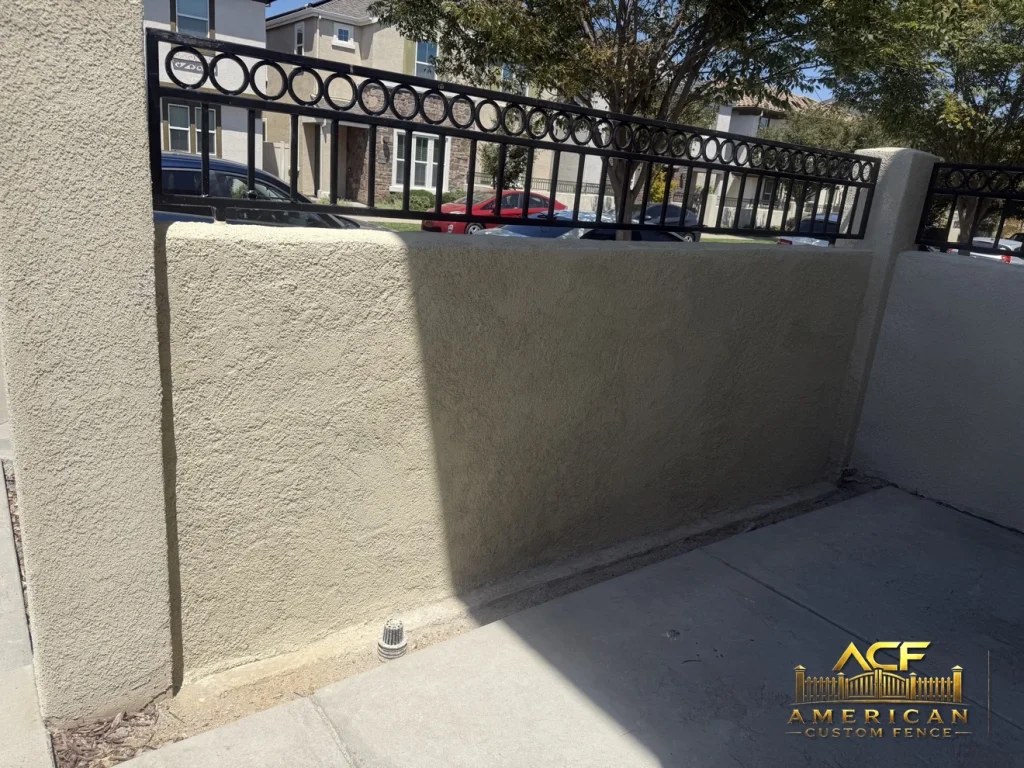
Individual backyard fences are the opposite case: they are normally the owner’s to replace — with the HOA’s written approval of the style the community requires.
The Pre-Build Checklist
Run through these HOA fence rules in order and a fence project in an HOA community stays boring — which is what you want.
- Get your documents. Declaration/CC&Rs, architectural guidelines, and the association’s written review procedure (the association must provide the procedure with its annual notice, §4765(c)).
- Find the fence rules specifically. Height, material, style, color/finish, placement, finished-side, and gate requirements — plus any like-for-like repair exception.
- Check the city layer. Your city’s height, setback, and clear-vision rules for your lot, and whether your project needs a city permit.
- Talk to the neighbor on any shared line — and for a shared boundary fence, give the written notice California law calls for.
- Submit the architectural application with dimensions, materials, color, and a sketch or photo of the style. Wait for the written approval, with any conditions, before scheduling work.
- Build exactly what was approved. If you want to change the height, style, or color mid-project, get the change approved in writing first.
- Keep the paperwork. The approval letter, the approved specs, and photos of the finished fence — they answer questions at resale and if a future board asks.
Building first and applying later is the expensive order. Associations can enforce their governing documents against an unapproved fence, and the remedy arguments happen after the money is spent — sometimes over a fence that would have been approved as submitted, or with one small change.
How We Work in HOA Communities
A good share of our Sacramento-area work is inside HOA communities, so following HOA fence rules and building to a written spec is second nature to us.
And approval never changes how the fence itself is built:
- Posts set 2 to 3 feet deep in concrete
- Waterproof wrap below ground on every post, at the ground line where rot starts
- Pressure-treated posts and rails, with redwood pickets for the face
- Simpson connectors and screws — never nails
The paperwork gets the fence approved. The build standard is what keeps it standing straight long after the approval letter is filed away.
Frequently Asked Questions
Do I need HOA approval to replace my fence with the same style and height?
Often yes — many associations require approval for any exterior change, including a like-for-like replacement. Some documents exempt exact like-for-like repairs. The answer is in your own CC&Rs and architectural guidelines, so check them (or ask the association in writing) before work starts.
My city allows a taller fence than my HOA does. Which rule applies?
Both — and the stricter one controls what you can actually build. City code sets the legal ceiling; your HOA can set a lower private limit for your community. Civil Code §4765(a)(3) also means an HOA decision cannot authorize anything that violates a building code or land-use law.
How long can the HOA take to decide on my fence application?
Civil Code §4765 requires the association’s procedure — which must be in its governing documents — to provide prompt deadlines and state the maximum time for a response. The specific number of days comes from your association’s own documents, so ask for the procedure and check. The decision itself must come back in writing.
What if my application is denied?
The written denial must explain why and describe the reconsideration procedure (§4765(a)(4)), and you are generally entitled to reconsideration by the board at an open meeting (§4765(a)(5)). Often the fastest path is adjusting the one element that failed — height, color, or style — and resubmitting.
Who pays to repair the masonry wall along our street?
Usually the association, if the wall is a common-area component: under Civil Code §4775, unless the declaration says otherwise, the association repairs, replaces, and maintains the common area. Read the declaration’s maintenance section — or ask the association — to confirm whose component your wall is.
Can the HOA make me match my neighbors’ fence color and style?
If its governing documents or architectural guidelines say so, generally yes — uniform height, style, and finish requirements are the most common fence rules in planned communities. Rules must be written and reasonable to be enforceable (§4350), and the recorded declaration outranks the operating rules if they conflict (§4205).
Planning a Fence in an HOA Community? Start With the Paperwork — We’ll Help With Both Halves
Bring us your fence line and, if you have them, your association’s guidelines. We’ll measure, confirm the design fits both your city’s rules and your HOA’s spec, and give you a written proposal you can attach to your architectural application — free, with no obligation.
Call American Custom Fence at (916) 579-3063 for a free estimate. Licensed, Bonded & Insured — CSLB License #1105341. Serving Sacramento and surrounding areas.
Sources: California Civil Code §4765 (architectural review procedures), §4775 (maintenance responsibilities), §4350 and §4355 (operating rules), and §4205 (governing-document hierarchy), Davis-Stirling Common Interest Development Act, California Legislative Information (leginfo.legislature.ca.gov); California Civil Code §841 (Good Neighbor Fence Act); City of Roseville, Code Compliance Brochure — Fences & Setbacks, Development Services Department — Code Enforcement (roseville.ca.us).
Regulations change. For the latest updates, please contact your city to confirm before building.