
Homeowners ask us this question as if it were a contest: “Which is better for a fence — redwood or pressure-treated?” It isn’t really a contest. In a well-built Sacramento redwood vs pressure-treated fence, the two materials do different jobs. Pressure-treated wood is the skeleton — the posts in the ground and the rails behind the face. Redwood is the face itself — the pickets you see, touch, and look at for the next decades.
Trouble starts when either material is asked to do the other’s job: redwood posts buried without ground-contact protection, or pressure-treated pickets used as the show face. This redwood vs pressure-treated fence guide explains what each material actually is, how the ratings work, and where each one belongs — so you can read any fence estimate and tell whether the materials match the job.
Two Different Kinds of Protection
Redwood’s protection grows in the tree. The reddish-brown heartwood at the center of a redwood log contains natural extractives — the tree’s own chemistry — that make it resistant to decay fungi and insects. The USDA Forest Products Laboratory’s Wood Handbook groups old-growth redwood heartwood as “Resistant” to decay and young-growth redwood heartwood as “Moderately resistant” (Chapter 14, Table 14–1). No factory adds that protection; it is in the wood itself, all the way through the board.
Pressure-treated wood’s protection is added at a plant. Lumber — in the West, commonly Douglas-fir or pine — is placed in a pressure cylinder and preservative is forced deep into the wood. Done to standard, that gives an otherwise non-durable species a rated defense against decay and insects in exposures it could never survive untreated.
The Redwood Trap: Heartwood Yes, Sapwood No
“Redwood” on an estimate is not enough information, because a redwood board is not all the same wood.
Redwood is graded for durability by color. The heartwood is reddish-brown; the sapwood — the outer growth layer of the tree — is cream-colored, and it does not carry the heartwood’s decay resistance. The Wood Handbook is blunt about sapwood generally: untreated sapwood of essentially all species has low resistance to decay.
The grading system makes this easy to check, if you know the code: every heartwood grade of redwood has the word “Heart” in its name — Clear All Heart, Heart B, Deck Heart, Construction Heart, Merchantable Heart. Grades without “Heart” — Construction Common, Deck Common, Merchantable — contain sapwood and are intended for above-ground work where decay risk is low.
The grade guide is explicit about the dividing line: for uses where the wood will be on or near soil — posts are the named example — it is essential to use one of the heartwood grades. A fence built from sapwood-heavy “redwood” pickets with pale, creamy streaks is not getting the durability the word redwood promises, especially on the bottom ends of pickets near soil and sprinkler spray.
The Pressure-Treated Trap: The Rating Is the Product
Pressure-treated lumber has its own version of the same trap. “Pressure-treated” is not one product — it is a family of products rated for different exposures under the AWPA Use Category System (Standard U1). The category is printed on the lumber’s end tag or stamp, and it decides where that board is allowed to serve:
- UC3B — Above Ground, Exposed. Exterior use, not in contact with the ground. The standard’s own examples include decking, railings, and fence pickets.
- UC4A — Ground Contact, General Use. Wood in contact with the ground or fresh water, or in other situations favorable to deterioration. The examples include sawn fence posts and deck posts.
- UC4B / UC4C — Ground Contact, Heavy / Extreme Duty. Higher preservative retention for severe environments and critical, hard-to-replace components.
Two details in the standard matter enormously on a fence:
- An above-ground board in the ground is the wrong product, full stop. A UC3B post is not “a little less treated” — it was never rated for soil contact. This is one of the most common reasons Sacramento fence posts rot out in a few seasons while the pickets above them still look fine.
- “Above ground” has a legalistic edge to it. U1 requires ground-contact treatment (UC4A or higher) even for some parts that never touch soil: components less than six inches above ground, parts where soil, mulch, or leaf litter can build up against the wood, parts wetted frequently — sprinkler spray counts — and parts that are critical to the structure and hard to replace. On a real fence, that describes the bottom rail on many yards and every post, every time.
Where Each Material Belongs in Your Redwood vs Pressure-Treated Fence
Put the two systems together and the Sacramento fence almost designs itself:
| Fence part | Exposure | What belongs there | Why |
|---|---|---|---|
| Posts | Buried, ground contact, critical & hard to replace | Pressure-treated, UC4A ground-contact rated (or higher) | Only a ground-contact rating is standardized for soil; treatment is consistent and verifiable on the tag |
| Rails | Above ground, but low rails sit in the splash/sprinkler zone | Pressure-treated | Bottom rails live within inches of soil and irrigation — U1’s own logic pushes them to ground-contact thinking; PT rails also sit hidden behind the pickets, where the face doesn’t matter |
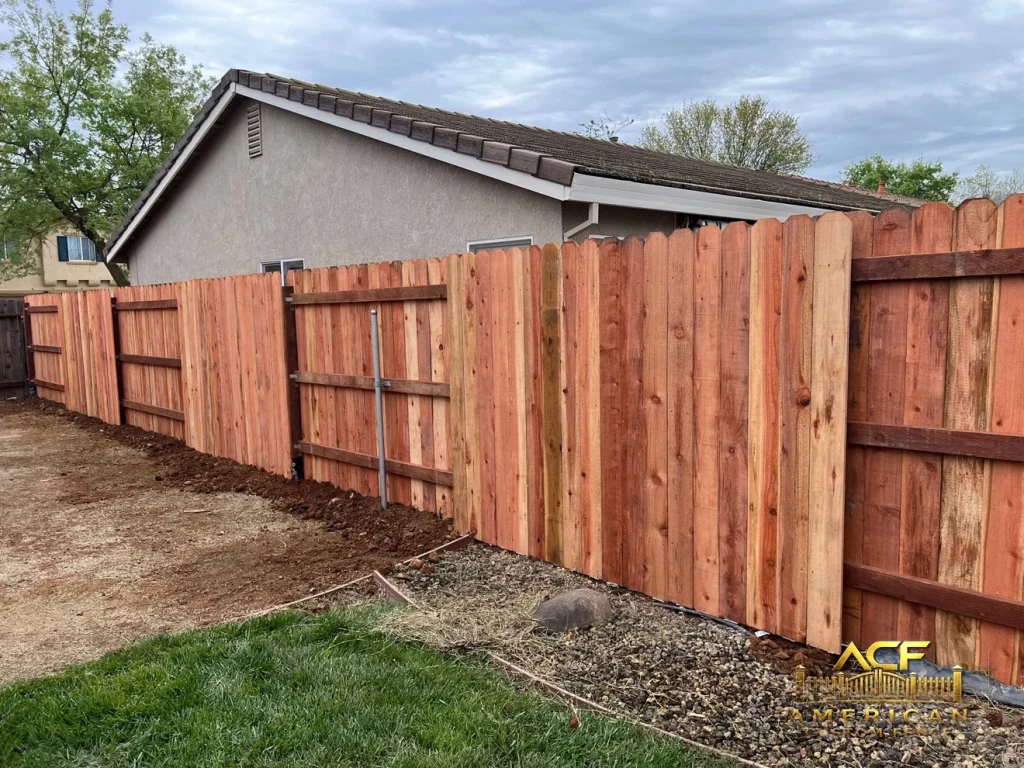
| Pickets | Above ground, exposed, the visible face | Redwood — heartwood grades for on/near-soil exposure; check for sapwood streaks | Natural decay resistance through the whole board, dimensional stability, and the warm color Sacramento homeowners actually want to look at |
| Gate frames | Above ground, moving, fastener-critical | Pressure-treated framing with redwood facing, or all-heart redwood | The frame needs stiffness and holding power; the face needs to match the fence |
Could you build the whole fence from redwood, posts included? All-heart redwood posts have a long California history, and the grade rules allow heartwood grades on or near soil. But a modern ground-contact-rated treated post gives you a protection level that is standardized and printed on a tag — where a redwood post’s protection depends entirely on how much true heartwood happens to be in that particular post. For the one component whose failure takes the whole fence down — and the hardest one to replace — we take the rated product, then add our own belt-and-suspenders: concrete and a waterproof wrap below ground (more on that below).
Could you build the whole fence from pressure-treated, pickets included? You could — UC3B explicitly lists fence pickets. But treated pickets are the working face of your fence: they tend to check, warp, and weather to a blotchy gray-brown, and they are usually a species chosen for treatability, not for looks or stability. Redwood pickets stay flatter, take stain evenly, and weather to the even silver or rich brown Sacramento yards are known for. The pickets are 100% of what you see. That’s the wrong place to economize.
Sacramento Conditions Decide the Details
Why does all this matter more here than in a lumber catalog? Because of where these fences live:
- Wet winters, baked summers. Wood swells, shrinks, and checks through the cycle. Redwood’s stability is a real advantage on the wide, visible picket face; movement in hidden PT framing matters far less.
- Clay soil that stays wet at the post base. The ground line is where posts die — the zone that stays damp longest while still getting air. That is precisely the exposure UC4A exists for, and precisely why “above-ground” posts fail there.
- Irrigation everywhere. Sprinklers wetting the bottom of a fence daily is “frequent wetting” in the standard’s terms — one more reason the bottom rail and picket ends deserve ground-contact thinking, not above-ground assumptions.
A Note on Fasteners — Where the Two Materials Meet
Modern pressure-treated lumber uses copper-based preservatives, and copper plus ordinary steel is a corrosion problem. Simpson Strong-Tie’s guidance for treated wood is clear: connectors and fasteners in treated lumber need to be hot-dip galvanized or stainless, matched to the treatment and exposure — and fastener and connector metals should match each other. That’s one reason our standard is Simpson connectors and screws, never nails: the right connector, in the right coating, driven with screws that hold as the wood moves through Sacramento’s seasons. A fence can have every board right and still fail early at cheap, corroding fasteners.
How We Build It — The Combination, Not the Contest
Our standard redwood vs pressure-treated fence uses each material where the standards and the exposure say it belongs:
- Pressure-treated posts, ground-contact rated, set 2 to 3 feet deep in concrete
- Waterproof wrap below ground on every post, sealing the ground-line zone where rot starts
- Pressure-treated rails behind the face
- Redwood pickets as the visible face — the warm, stable, naturally resistant surface you actually live with
- Simpson connectors and screws — never nails — with coatings matched to treated wood
Posts are the bones, redwood is the face, and the ratings — AWPA for the treated lumber, “Heart” grades for the redwood — are how you verify you’re getting what the estimate claims.
Frequently Asked Questions
Is redwood or pressure-treated better for fence posts?
For posts, the deciding factor is the ground-contact rating, not the species name. A pressure-treated post tagged UC4A (or higher) carries a standardized rating for soil contact. A redwood post’s protection depends on it being a true heartwood grade — the grade rules allow heartwood grades on or near soil, but a sapwood-containing redwood post has no business in the ground. We use ground-contact-rated treated posts, set in concrete and wrapped below ground.
Can I use pressure-treated wood for pickets?
The AWPA standard lists fence pickets as an above-ground (UC3B) use, so yes, it’s a rated application. We don’t recommend it as the visible face: treated pickets typically weather unevenly and move more than redwood. Pickets are everything you see — that’s where redwood earns its place.
The estimate just says “redwood fence.” What should I ask?
Ask which grade. If the answer doesn’t include the word “Heart” for boards that will sit on or near soil, you’re likely getting sapwood-containing material (Construction Common, Deck Common) whose pale sapwood has low decay resistance — the Wood Handbook says that of sapwood generally. Also ask what the posts are and what their use-category tag says.
How can I check pressure-treated lumber myself?
Read the end tag or ink stamp before it’s buried: look for the AWPA use category — UC4A or higher for anything touching soil, UC3B only for genuinely above-ground parts. If a post has no tag or stamp showing a ground-contact rating, don’t let it go in the ground.
Does pressure-treated wood still need the waterproof post wrap you use?
Treatment and the wrap do different jobs. The treatment protects the wood fiber itself to a rated standard; the wrap seals the post’s surface at the ground line — the wettest, most decay-active zone — against constant soil moisture contact. We use both, the same way the fence uses both materials: each where it works best.
Planning a Fence? Get the Materials in Writing
A good estimate names the materials precisely — ground-contact-rated treated posts and rails, redwood pickets, the connectors and fasteners — not just the footage. For your redwood vs pressure-treated fence, we’ll walk your fence line, talk through the options for your yard, and put it all in a written proposal, free with no obligation.
Call American Custom Fence at (916) 579-3063 for a free estimate. Licensed, Bonded & Insured — CSLB License #1105341. Serving Sacramento and surrounding areas.
Sources: AWPA Standard U1, Use Category System (American Wood Protection Association, awpa.com); USDA Forest Products Laboratory, Wood Handbook — Wood as an Engineering Material, Chapter 14: Biodeterioration of Wood, Table 14–1 (fpl.fs.usda.gov); Redwood Inspection Service grading rules for redwood lumber (heartwood/sapwood grades); Simpson Strong-Tie corrosion guidance for preservative-treated wood (strongtie.com).