
Every fence has exactly one moving part, and it is the part you touch every day. A fence panel can be built perfectly and stand untouched for decades; a gate is lifted, swung, latched, leaned on, and left hanging off one post for its entire life. So when a fence starts to feel old, it is almost never the fence. It is the gate — dragging on the ground, missing its latch, needing a hip-check to close.
Sag is not bad luck, and it is rarely the wood’s fault. It is physics, applied slowly. The good news is that physics can be designed for. This guide walks through why gates sag, the four places the failure actually starts, and how to choose — or fix — a gate that keeps swinging true.
Why Gates Sag: A Rectangle Trying to Become a Parallelogram
A gate is a cantilever: its whole weight hangs off the hinge post, and the latch side has no support at all. Gravity pulls that unsupported side down every minute of every day, and the pull grows with the gate’s width and weight — a wide, heavy leaf twists its hinges and post far harder than a narrow, light one.
The frame itself cooperates with gravity. A plain rectangle is not a rigid shape: under a steady downward load on one corner it racks — the corners leave 90 degrees and the rectangle slumps into a parallelogram, the top rail sloping, the latch-side bottom corner dropping toward the dirt. Add the daily cycle of swinging and slamming, and joints that started tight work themselves looser season after season.
Wood adds one more force. The USDA Forest Products Laboratory’s Wood Handbook (Chapter 4) explains that wood is hygroscopic — it takes on and gives off moisture with the air — and below the fiber saturation point it swells as it gains moisture and shrinks as it loses it, a cycle that “can result in warping, checking, and splitting.” A gate that gets heavier when wet, moves as it dries, and is fastened with smooth nails is a gate whose joints are being worked from the inside as well as the outside.
Every sagging gate we are called to look at traces back to one or more of four failure points: the frame, the hardware, the post, or the width. Here is each one — and what actually prevents it.
Failure Point 1: The Frame Has No Triangle in It
The fix for racking is the oldest shape in construction: the triangle. Modern Fence Technologies, which manufactures gate hardware, puts it plainly — trusses are based on triangles, “among the most stable of geometric constructs,” and a gate frame becomes stable the same way a truss does, by adding a diagonal that divides the rectangle into triangles.
For a wood gate, that diagonal is the brace in a Z-brace frame, and its direction is not a matter of taste:
- A rigid wood brace works in compression. It runs from the bottom corner on the hinge side up to the top corner on the latch side. When gravity tries to drop the latch side, that movement would have to shorten the brace — and wood resists being shortened with its full strength, pushing the load back into the hinge post instead. The Folsom gate in this article’s photo is built exactly this way: look at the diagonal rising from the bottom hinge-side corner to the top latch-side corner.
- A steel cable works in tension, so it runs the opposite way — from the top hinge-side corner down to the bottom latch-side corner, with a turnbuckle to draw it tight. A cable can only pull, never push, so it has to be rigged along the diagonal that sag tries to stretch. This is why anti-sag cable kits are a repair for an existing wood gate, while the compression brace is how a new one should be built.
- Angle matters as much as direction. Modern Fence Technologies’ rule is to keep diagonal braces at 45 degrees or less, so the brace delivers a vertical supporting force against gravity rather than a mostly horizontal push that twists the frame. A very wide, short gate forces a shallow, weak brace angle — one of several reasons wide openings belong in two leaves, not one (below).
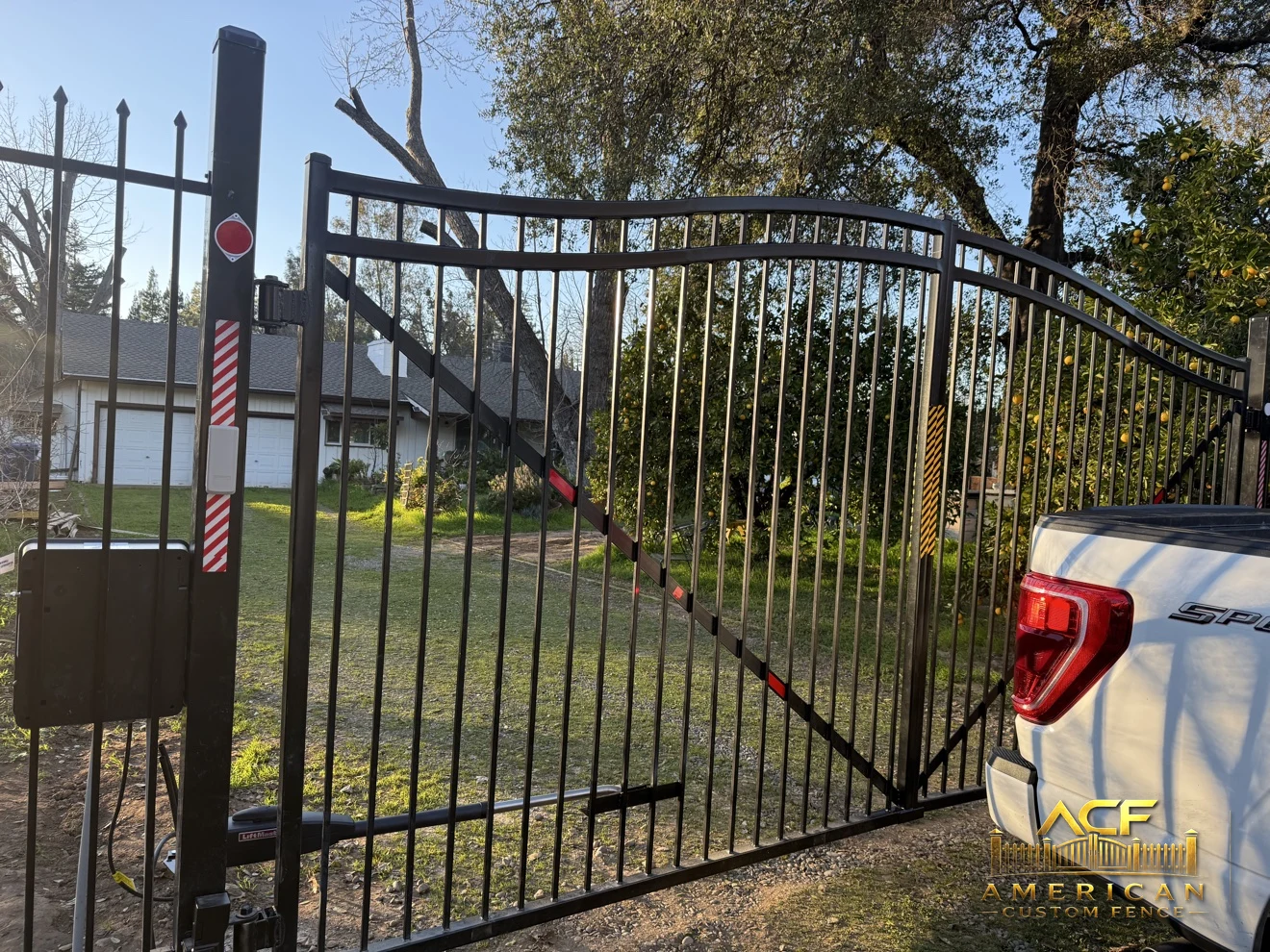
Metal gates solve the same problem with a welded or mechanically fastened frame sized to the opening, its own diagonal built in — the black driveway gate in the second photo carries its brace as part of the steel frame. Either way, the principle does not change with the material: no triangle, no long-term square.
Failure Point 2: Hinges Chosen by Eye Instead of by Weight
Hinges are not a style choice; they are a rated component. Manufacturers size them against numbers. TIMCO’s exterior gate hinge tables, for example, specify each tee hinge by the gate width it suits and a maximum gate weight — the ranges run from light hinges for narrow, light gates up to strong tee hinges rated for gates up to about 1,800 mm wide and 80 kg. A gate hung on hinges rated below its real weight does not fail dramatically; it fails gradually, the knuckles wearing and the screws working in their holes until the leaf drops.
Three hardware habits separate a gate that lasts from a gate that sags:
- Match the hinge to the gate’s weight and width, with margin. Long strap and T-hinges spread the load across the gate’s rail instead of concentrating it at one small leaf — which is why the Folsom gate hangs on three black T-hinges, not two small butt hinges.
- Add a third hinge on tall or heavy gates. TIMCO’s guidance, repeated across its hinge range, is that doors and gates over 7 feet in height should be fitted with a third hinge to prevent warping; the same logic applies to any unusually heavy leaf, where the middle hinge shares a load two hinges would otherwise carry alone.
- Screw it, with the right metal. We fasten with Simpson connectors and screws — never nails — because a screw’s threads hold against the withdrawal forces that pry a hinge loose, while a smooth nail walks out a fraction with every swing. Outdoors, the metal has to match the wood: Simpson Strong-Tie specifies its ZMAX galvanized finish for connectors used on exterior projects and preservative-treated wood, because treated lumber is corrosive to plain steel hardware.
Failure Point 3: The Post Moves — and Takes the Gate With It
Some “sagging gates” are not sagging at all. The frame is square, the hinges are sound — and the hinge post has leaned a few degrees under the constant sideways pull of the gate’s weight, carrying the leaf down with it. Gate posts take more stress than any other post in the fence line: they carry a moving, twisting load, not a static panel.
That is why we set gate posts the way we set all our posts, only more so: 2 to 3 feet deep in concrete, with extra concrete at the gate post, so the post cannot creep as the gate swings. The underground half matters as much as the depth. As this blog covered in “Why Fence Posts Fail — and How We Set Ours”, the ground line is where moisture and oxygen meet the wood and rot does its work (USDA Wood Handbook, Chapter 14) — which is why our posts are pressure-treated and wrapped with a waterproof wrap below ground. A gate post that rots at the ground line starts to lean long before it falls, and the first symptom is a gate that “suddenly” drags.
Before blaming any gate, check the post: sight down it, push it, look for a gap opening on one side of the concrete. If the post moves, no adjustment to the gate will hold — the post has to be reset or replaced first. Our Gates page says the same thing we say at estimates: if the post has shifted, a new gate on a bad post won’t fix anything.
Failure Point 4: One Leaf Asked to Span Too Much
Leverage is unforgiving. Doubling a gate’s width far more than doubles the twisting force at the hinges, because the weight sits twice as far from the post that carries it — and, as noted above, a wide leaf also forces its brace into a weak, shallow angle.
Our rule, stated on our Gates page: single walk gates are typically 3 to 5 feet wide; wider openings work better as double gates, so each leaf stays light enough — and its brace angle steep enough — to hang straight for years. A double gate also halves the swing space each leaf needs. For a genuinely wide single opening that cannot be split, the honest upgrades are a welded steel frame, heavy rated hinges, and sometimes a gate wheel at the latch side to carry the leaf’s weight across a hard, level surface — the Folsom gate in the photo runs a wheel for exactly this reason. A wheel is a support, not a cure: it only works where it has smooth concrete to roll on, and it never rescues a racked frame or a leaning post.
Already Sagging? Diagnose Before You Spend
A sagging gate can often be squared again — if you fix the part that actually failed, in the right order:
- Check the post first. Plumb and solid, or leaning and soft at the base? Post problems get fixed before anything else, because every later adjustment hangs off that post.
- Check the frame for square. Measure both diagonals of the gate itself. If they differ, the frame has racked. Simpson Strong-Tie’s fence repair guidance (cutsheet DIY-CSFNCRPR17) describes the standard repair: lift the latch side until the frame is square again, prop it there, then install Rigid Tie RTA2 connectors in the corners “to hold them at 90° and provide support to the gate,” fastened with connector screws. A turnbuckle cable kit along the tension diagonal can hold the same correction on a lighter gate.
- Check the hardware. Bent hinge leaves, elongated screw holes, and screws that spin instead of biting mean the hardware — or the wood under it — has given up. Longer screws into sound wood or through-bolts can save a frame; hinges rated for the gate’s actual weight replace the ones that were guessed at.
- Know when it is done. A frame whose rails have split at the joints, pickets rotting where they meet the rails, or a post rotted through at the ground line is not a repair — it is a replacement with extra steps. We will tell you which one you have at the estimate, and a gate-only replacement on sound posts is a common, sensible job.
One case deserves urgency rather than patience: a pool gate. A gate that sags even slightly can stop self-latching, and as our pool fence article explains, California’s enclosure rules require the gate to be self-closing and self-latching. A dragging pool gate is not a nuisance; it is a safety feature that has stopped working.
How We Build a Gate
Measured and built for your exact opening, your slope, and your swing direction:
- A real frame, not boards on hinges — wood gates get a braced frame with the diagonal in compression, running from the bottom hinge-side corner to the top latch-side corner; metal gates get a welded or mechanically fastened frame sized to the opening.
- Posts that carry the load — gate posts set 2 to 3 feet deep in concrete with extra concrete at the post, pressure-treated and wrapped below ground.
- Hardware matched to the gate — hinges and latches sized to the leaf’s weight and width, fastened with Simpson connectors and screws, never nails; a third hinge where the gate’s height or weight calls for it.
- Adjusted before we leave — hung plumb and swung until it latches cleanly.
Every gate we install is covered by our 12-month workmanship warranty on work performed completely by us. And when the work is finished, the walkthrough is an invitation to swing the gate with us and look the build over — never a sign-off or a payment condition.
Frequently Asked Questions
Which way should the diagonal brace run on a wood gate? From the bottom corner on the hinge side up to the top corner on the latch side. Built that way, the brace works in compression — the direction in which wood is strongest — and carries the latch side’s weight back to the hinge post. A cable-and-turnbuckle kit runs the opposite diagonal, because a cable works in tension; mixing the two directions up is the most common bracing mistake we see.
How wide can a single gate be before it sags? There is no magic number, but leverage grows fast with width. In our work, single walk gates are typically 3 to 5 feet; beyond that, a double gate — two lighter leaves, each with a steep, effective brace angle — hangs straight far longer than one wide leaf on the same posts.
Can a sagging gate be fixed, or does it need replacing? Often fixed, if the frame’s wood is sound: re-square the frame, lock the corners with connectors or a tension cable, and fit hinges rated for the gate’s weight. If the post has leaned or rotted, that gets fixed first. Split rails, rotted joints, or a post rotted at the ground line mean replacement is the honest answer.
Does a third hinge really help? Yes, on the gates that need it. Hinge manufacturers such as TIMCO specify a third hinge for gates over 7 feet tall to prevent warping, and a middle hinge shares the twisting load on any heavy leaf instead of leaving it all on two hinge points and their screws.
Will a gate wheel stop my gate from sagging? A wheel supports the latch side and can help a wide, heavy gate — the Folsom gate in this article’s photo uses one — but only on a hard, level surface it can roll on. It does not straighten a racked frame, re-plumb a leaning post, or substitute for a proper brace.
My gate only drags in winter. Is that normal? It is common, and it is the moisture cycle at work: wood swells as it gains moisture and shrinks as it dries (USDA Wood Handbook, Chapter 4), so a gate hung with almost no clearance can bind in the wet season. It is also a warning to heed early — a gate adjusted with proper clearance, a braced frame, and a solid post rides out the seasons instead of grinding through them.
Planning a Gate in the Sacramento Area?
Tell us the opening, what has to pass through it, and how the gate gets used day to day, and we will lay out a gate built to stay square — braced frame, matched hardware, and a post set to carry it.
Call American Custom Fence at (916) 579-3063 for a free estimate. Licensed, Bonded & Insured — CSLB License #1105341. Serving Sacramento and surrounding areas.
Sources: Simpson Strong-Tie, “DIY: Fence Repair,” cutsheet DIY-CSFNCRPR17 (sagging-gate repair: lift the latch side until the frame is square, install Rigid Tie RTA2 connectors in the corners to hold them at 90°, fastened with #9 SD Connector screws; ZMAX galvanized connectors recommended for exterior projects and preservative-treated wood); Modern Fence Technologies, “Building a Better Gate” (gates stabilized as triangular trusses; diagonal braces kept to 45 degrees or less so the brace applies a vertical supporting force); TIMCO, “Exterior Gate & Door Hinges” brochure (hinges specified by gate width and maximum gate weight; doors/gates over 7 ft in height should be fitted with a third hinge to prevent warping); USDA Forest Products Laboratory, Wood Handbook, Chapter 4 — Moisture Relations and Physical Properties of Wood (wood swells and shrinks with moisture change below the fiber saturation point, which can result in warping, checking and splitting) and Chapter 14 (moisture-driven decay; the ground line as the harshest zone for posts).