
Ask ten fence sellers how long chain link lasts and you will hear ten different numbers in years. Here is the honest starting point: no chain-link standard gives a fence a lifespan in years. ASTM A392 for galvanized fabric and ASTM F668 for polymer-coated fabric do not promise years — they specify coatings. The years follow from the coating.
That is actually good news for a homeowner, because a coating can be checked. You can ask which class of fabric you are buying, how much zinc is on the wire, and whether vinyl sits over galvanized steel or over something thinner. This guide explains those choices in plain terms, using the manufacturers’ own published specifications.
A Chain-Link Fence Is a System, Not Just Fabric
The fabric — the diamond mesh — is the part everyone sees, and the Chain Link Fence Manufacturers Institute (CLFMI) describes it simply: interwoven steel wires forming a diamond pattern, available in various heights, gauges and coatings, galvanized or vinyl-coated. CLFMI’s point for homeowners is that quality chain link uses rust-resistant metallic coatings on steel wire, and that the protective coatings, both metal and polymer, are what inhibit rust.
But a fence is fabric plus framework: terminal posts, line posts, top rail, tension wire and fittings. The fabric can be in fine shape while a leaning terminal post lets the whole run go slack — chain link only stays tight because it is stretched tight between posts set in concrete. When we talk about how long a chain-link fence lasts, we mean the whole system, and the weakest part sets the date.
Galvanized: Zinc Does the Work, and Weight Is the Measure
Galvanized chain link is steel wire coated with zinc. The American Galvanizers Association (AGA) explains why zinc works so well: it gives two kinds of protection at once. It is a barrier that keeps moisture and air off the steel, and it is cathodic — sacrificial — protection. Zinc corrodes preferentially, before the steel under it. The AGA’s specifier’s guide goes further: even where a small area of steel is exposed, up to 1/4 inch in diameter, no corrosion begins until all the surrounding zinc is consumed.
Because the zinc is consumed slowly over time, how much zinc there is matters more than almost anything else. The AGA states the rule plainly: the time to first maintenance of a galvanized coating is directly proportional to its thickness. “Time to first maintenance” has a precise meaning in their work — the time until 5% of the steel surface shows rust.
ASTM A392 turns that rule into two buyable classes for chain-link fabric, in Merchants Metals’ published specification:
- Class 1: minimum 1.2 ounces of zinc per square foot.
- Class 2: minimum 2.0 ounces of zinc per square foot.
Class 2 carries about two-thirds more zinc than Class 1. On the AGA’s proportional rule, that is not a small upgrade — it is the single clearest lifespan difference you can buy in galvanized fabric. Merchants Metals puts a warranty behind the heavier class: its Class 2 galvanized fabric is warranted for 20 years against failure due to rust or corrosion. That is a manufacturer’s warranty on its fabric, on its own terms — not a promise that every fence will look new at year 20, and not our workmanship warranty. The two are kept separate below.
GBW vs. GAW: When the Zinc Goes On
The same Merchants Metals specification explains a second distinction most buyers never hear:
- Galvanized before weaving (GBW): the wire is cleaned, passed through a bath of molten zinc, and then woven into fabric.
- Galvanized after weaving (GAW): the uncoated wire is woven first, then the woven mesh is cleaned and passed through a molten zinc bath as a finished sheet.
In GAW, the zinc coats the finished mesh, including the woven joints where wires cross and twist. In GBW, the coating goes on before the wire is bent and woven. The practical buying rule from the specification is simple: GAW is available in either coating class, while GBW is limited to Class 1. So if you want the heavier Class 2 coating, you are in GAW territory. The specification also notes that 11-gauge fabric — the lightest common residential wire — is available with a Class 1 coating only, and fabric in mesh sizes under 1-3/4 inches is GBW.
Gauge: The Wire Under the Coating
Gauge is wire thickness, and lower numbers are thicker wire. Merchants Metals’ Table 1 for ASTM A392 fabric, at a minimum tensile strength of 75,000 psi, lists minimum breaking strengths of:
- 6 gauge: 2,170 pounds-force
- 9 gauge: 1,290 pounds-force
- 11 gauge: 850 pounds-force
Thicker wire is harder to cut, holds tension better, and tolerates impacts — a leaning ladder, a dog throwing its weight at the fence, a fallen branch — with less permanent distortion. For a quiet side yard, standard residential gauge does its job for a long time. For a dog run, a school or park edge, or any line where security matters, stepping up in gauge is a lifespan decision as much as a strength decision, because a fence that gets bent out of shape early is a fence that gets replaced early.
Vinyl-Coated: A Second Coat Over the Zinc
Vinyl-coated chain link is not painted steel, and it is not vinyl instead of galvanizing. Under ASTM F668, polymer-coated fabric starts with metallic-coated — galvanized — core wire, and the polymer goes over it before weaving.
Merchants Metals’ Class 2a specification describes the build in detail: the core wire is galvanized first, a molecular bonding agent is applied to that galvanized wire so the PVC cannot slip, and PVC up to 0.025 inch thick is then pressure-bonded to the wire. The result, in the manufacturer’s words, is a dense, impervious coating free of voids. The vinyl is continuously bonded over the galvanized wire, and the finished fabric stays free and flexible at the joints.
ASTM F668 sorts polymer-coated fabric into three classes by how the coating is attached:
- Class 1: polymer extruded over metallic-coated wire.
- Class 2a: polymer extruded and adhered to metallic-coated wire.
- Class 2b: polymer fused and adhered to metallic-coated wire.
The adhered classes exist for a reason: a coating that is bonded to the wire is harder to peel, slip or open at a cut end than a loose sleeve of plastic. Merchants Metals warrants its extruded-and-adhered PVC-coated fabric for 15 years against failure due to rust or corrosion — again, a manufacturer’s fabric warranty, separate from our workmanship warranty.
Two honest points about vinyl-coated fabric:
- The zinc underneath is thinner. In the Class 2a table, the minimum zinc coating weight on the core wire is 0.30 oz/ft² for 9-gauge and 11-gauge core wire — far less than the 1.2 or 2.0 oz/ft² of galvanized A392 fabric. The system works because the bonded PVC is the main barrier and the zinc is the back-up at scratches and cut ends. That trade is reasonable — as long as the PVC stays intact.
- Damage matters more. The same specification requires that if the PVC coating is damaged during installation, the contractor must replace or repair the material at his own expense. A deep gouge that cuts through vinyl to the core removes the main barrier at that spot. Vinyl-coated fabric rewards careful handling and honest repair of damage; galvanized fabric is more forgiving of scratches, because its zinc protects small exposed areas sacrificially.
And one buying trap F668 clears up: for polymer-coated fabric, the gauge in the specification is the gauge of the steel core wire, not the thicker finished diameter with vinyl on it. A roll quoted by its finished size can sound heavier than it is. Ask for the core gauge.
Vinyl also brings color. Standard colors under ASTM F934, per the manufacturer, are dark green, brown and black — which is why vinyl-coated chain link blends into landscaping in a way bright galvanized fabric does not, and why many HOAs that restrict chain link accept the coated version more readily. Check your own HOA’s rules before you choose; every association is different.
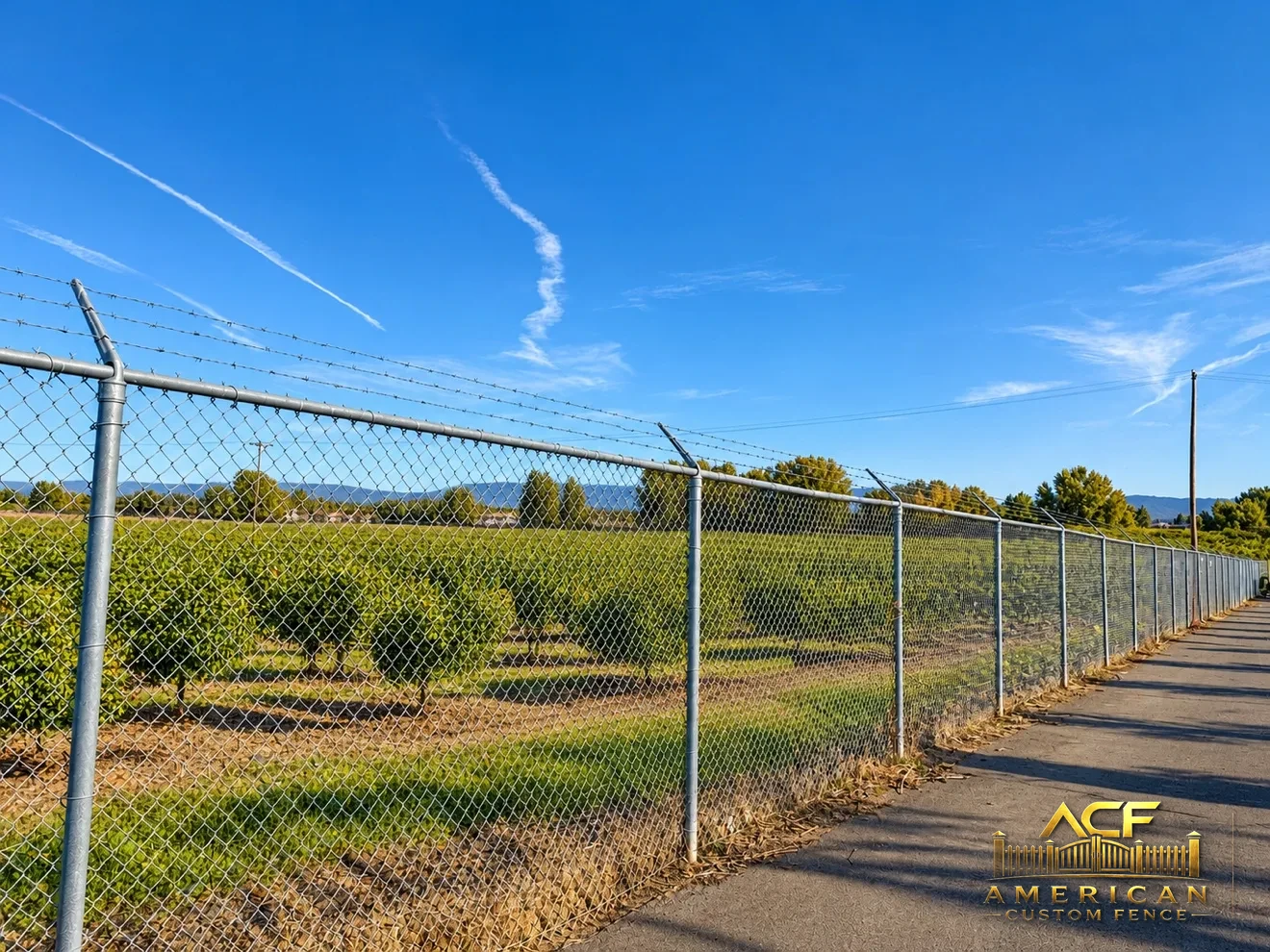
So How Long, in Sacramento?
Put the pieces together for our area. Sacramento is an inland, suburban environment — not marine air, not heavy industry. On the AGA’s five-environment scale (rural, suburban, temperate marine, tropical marine, industrial), that is one of the kinder settings for zinc. What shortens chain-link life here is local, not regional:
- Sprinklers hitting the same run every day, keeping the bottom of the fabric and the post bases wet.
- Soil and mulch piled against the fabric, holding moisture against the coating at ground level.
- Damage left alone — a cut tie wire, a bent section, a gouged vinyl coating — where a small repair would have closed the opening.
- Posts and fittings, which often age out before good fabric does if they were lightly coated or shallowly set.
With those managed, the manufacturers’ own warranty anchors tell the practical story: a heavier Class 2 galvanized fabric carries a 20-year manufacturer warranty against rust-through failure, and a bonded vinyl-over-galvanized fabric carries a 15-year manufacturer warranty. A well-built fence with sound posts should be planned around decades of service, with periodic inspection — the galvanized specification itself recommends periodic inspection and calls for no routine maintenance. A light Class 1 fabric on lightly built framework is a shorter-life purchase, and it is usually priced that way for a reason. We do not print prices, because the honest number depends on your lot — but on chain link, the drivers are exactly the choices above: coating class, core gauge, framework weight, post depth and concrete, and gate hardware.
How We Build — and What We Warranty
We install chain-link fences across the Sacramento area the same careful way we build every fence: terminal posts set in concrete, posts set 2 to 3 feet deep, fabric stretched tight and tied properly so the fence stays drum-tight instead of sagging between posts, and gates hung level with hardware that works every time. At the free estimate we will name the fabric’s coating class and core gauge in writing, so you can compare our quote against any other on the actual specification — not on a promise in years.
Every fence we build in full carries our 24-month workmanship warranty on work performed completely by us, for projects contracted from November 4, 2026. Any warranty a manufacturer offers on its fabric is the manufacturer’s own, on its own terms — we will show you exactly which is which before you sign, because the two are never the same thing.
Frequently Asked Questions
Does vinyl-coated chain link last longer than galvanized?
They protect the wire differently. Galvanized fabric relies on zinc, and the heavier Class 2 coating (2.0 oz/ft²) carries a 20-year manufacturer warranty against rust-through. Bonded vinyl-over-galvanized fabric adds a thick PVC barrier over a thinner zinc layer and carries a 15-year manufacturer warranty in the Class 2a specification we cite. Vinyl looks softer and blends into a yard; galvanized is more forgiving of scratches. The right choice depends on looks, HOA rules and how rough the fence’s life will be.
What does GBW and GAW mean when I am comparing quotes?
Galvanized before weaving vs. galvanized after weaving. GAW coats the finished mesh, joints included, and is available in both zinc classes; GBW is limited to Class 1. If a quote just says “galvanized,” ask which one — and which class.
Is 11-gauge fabric enough for a backyard?
For a quiet residential line, 11-gauge is a common, serviceable choice — but note that it is available with a Class 1 coating only, and its minimum breaking strength (850 lbf) is well below 9-gauge (1,290 lbf). For dogs that hit the fence, long runs, or any security purpose, we will usually recommend stepping up.
Why did my old chain-link fence rust at the bottom first?
The bottom lives wet: sprinkler spray, soil and mulch against the fabric, and debris held at the ground line keep moisture on the coating where the fence dries slowest. It is the same ground-line principle that rots wood posts. Keeping grade and mulch off the fabric, and fixing coating damage early, slows it down.
Can a rusted section be replaced without replacing the whole fence?
Often, yes — fabric can be re-stretched or a section replaced if the posts and framework are sound and well coated. If the framework is leaning or rusted through, replacing fabric alone puts new material on a failing frame. We will tell you honestly which case yours is at the estimate.
Does chain link need maintenance?
The galvanized specification says no routine maintenance is required, but periodic inspection is recommended. Walk the line once in a while: look for coating damage, loose ties, leaning posts and soil building up against the fabric, and deal with small findings while they are still small.
The Short Answer
No standard promises a chain-link fence a number of years — the coating class is the promise you can verify. Zinc weight (Class 1 at 1.2 oz/ft² vs. Class 2 at 2.0 oz/ft²), GAW over GBW when you want the heavier class, core gauge, and bonded vinyl over galvanized steel are the choices that decide whether a fence is a short-life purchase or a decades-long one. Buy the specification, not the slogan — and make sure the posts and framework are built to last as long as the fabric.
Call American Custom Fence at (916) 579-3063 for a free estimate. Licensed, Insured & Bonded — CSLB License #1105341. Serving Sacramento and surrounding areas.
Sources: Merchants Metals, “Zinc Coated (Galvanized) Steel Chain Link Fence Fabric” specification, ASTM A392 (GBW and GAW defined; Class 1 minimum 1.2 oz/ft² and Class 2 minimum 2.0 oz/ft² zinc; GAW available in either class, GBW limited to Class 1; 11-gauge fabric Class 1 only; Table 1 minimum breaking strengths 6 ga 2,170 lbf, 9 ga 1,290 lbf, 11 ga 850 lbf at 75,000 psi minimum tensile strength; Class 2 galvanized fabric warranted 20 years against failure due to rust or corrosion; periodic inspection recommended, no routine maintenance required); Merchants Metals, “Extruded and Adhered Polyvinyl Chloride (PVC) Coated Steel Chain Link Fence Fabric” specification, ASTM F668 Class 2a (galvanized core wire, bonding agent applied to eliminate slippage, PVC up to 0.025 in. pressure-bonded, dense and impervious coating free of voids, continuously bonded over the galvanized wire, coated before weaving; minimum zinc on core wire 0.30 oz/ft² for 9- and 11-gauge; ASTM F668 specifies the steel core as the wire gauge; standard colors dark green, brown and black per ASTM F934; damaged PVC during installation must be replaced or repaired by the contractor; extruded-and-adhered PVC-coated fabric warranted 15 years against failure due to rust or corrosion); ASTM F668-17 (reapproved 2022) scope (polymer-coated fabric coated before weaving in Class 1 extruded, Class 2a extruded and adhered, and Class 2b fused and adhered constructions); American Galvanizers Association, “Hot-Dip Galvanizing for Corrosion Protection — A Specifier’s Guide” and AGA publications (zinc provides barrier and cathodic/sacrificial protection; exposed steel up to 1/4 in. in diameter does not corrode until surrounding zinc is consumed; time to first maintenance is directly proportional to zinc coating thickness and is defined as time to 5% rusting of the steel surface; 1 mil = 0.56 oz/ft²; five environments — rural, suburban, temperate marine, tropical marine, industrial); Chain Link Fence Manufacturers Institute (chainlinkinfo.org — fabric is interwoven steel wire in a diamond pattern in various heights, gauges and coatings; quality chain link uses rust-resistant metallic coatings; metal and polymer protective coatings inhibit rust).